Thursday, January 30, 2014

Saturday, December 21, 2013
Kidnapped Taiwanese released in Sulu
MANILA, Philippines (Xinhua) - A female Taiwanese who was kidnapped in Malaysia last month was freed in Sulu yesterday afternoon, local military said today.
The victim, identified as Evelyn Chang, was rescued by joint military and police units at Liban village in Talipao town at around 3:55 p.m. local time, said Captain Ryan Lacuesta, civil military operations officer of the 2nd Marine Brigade.
He said authorities received information from Talipao residents regarding the kidnapped victim who was apparently abandoned by her unidentified captors.
Chang was seized on Nov. 15 at Pulao, Pulong-Pulong, Sampurna, Sabah, Malaysia and was brought to the municipality of Indanan, Sulu.
The recovered kidnap victim was immediately brought to Camp Teodulfo Bautista Station Hospital for medical check up and trauma treatment, said Lacuesta, who did not mention if ransom was paid for Chang's safe release
.http://www.philstar.com/headlines/2013/12/21/1270726/kidnapped-taiwanese-released-sulu
Aquino thanks Ban for UN help in typhoon-hit areas
MANILA, Philippines (Xinhua) - President Benigno S. Aquino III personally thanked today visiting United Nations (UN) Secretary-General Ban Ki-Moon for the assistance and concern that the agency has been extending to the country after it was hit by typhoon Haiyan last November.
Aquino expressed his gratitude during the courtesy call made by Ban Ki-Moon in Malacanang, the presidential palace, before the latter flew to Tacloban in central Philippine province of Leyte, the worst-hit area by typhoon Haiyan, locally known as Yolanda.
Aquino and the UN chief discussed the recovery and reconstruction efforts for the typhoon-ravaged areas, said Deputy Presidential Spokesperson Abigail Valte in an interview with a state-run radio station.
Ban arrived in the country Friday night and will be staying until Sunday. He is going to visit the worst-devastated areas to personally assess the damage and express solidarity to the victims of Haiyan, which is considered as the strongest typhoon ever hit the planet in recent years.
The latest official death toll from Haiyan in the Philippines has climbed to 6,102, while the number of those missing was still at 1,779.
Sunday, December 1, 2013
Only good stuff, please, aid workers tell donors
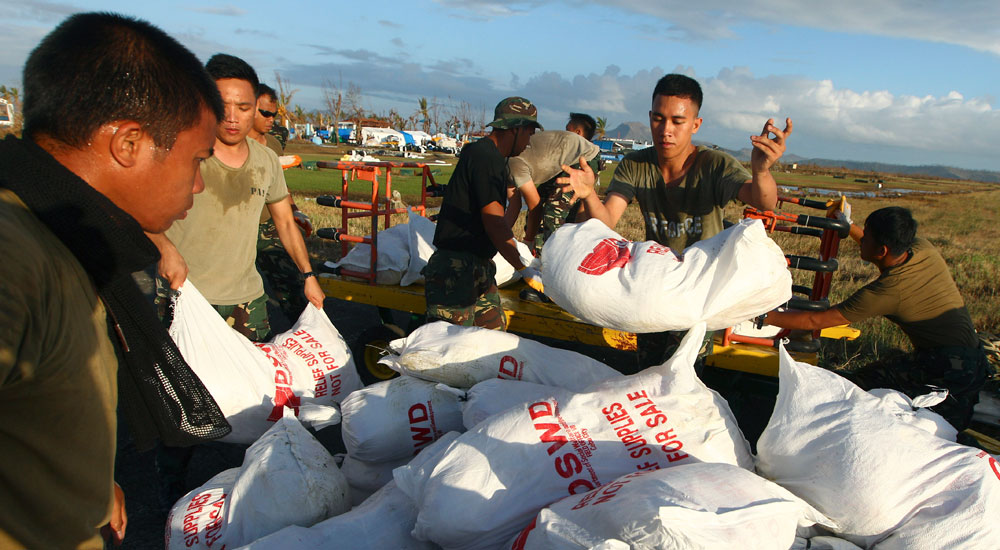
Philippine military personnel unload relief goods to be distributed to those affected by Typhoon Haiyan at the airport in Tacloban. AP FILE PHOTO
BORONGAN CITY, Eastern Samar—Disaster relief officials here on Friday appealed to donors to give only goods that were usable to avoid further delays in their distribution to survivors of Supertyphoon “Yolanda.”
Social welfare officer Victoria Tagum, who heads the distribution of relief in Eastern Samar, said donations still had to be sorted because many contained items that were no longer of any use.
“We have to take those out. Giving them to the typhoon victims would be an added insult,” she said.
Tagum said volunteers had found donated items, mainly clothes and slippers and shoes, that were too worn out to be of any use to the victims.
Cause of delay
Other items included bags and school supplies that were ruined.
“While we are grateful for the donations that have been coming in, we are calling on the public to donate things that are still usable because [sorting them out] would entail another day of delay,” she said.
Contaminated
Aside from unusable items, relief workers also had to repack bags of food items that were damaged during the two-day 450-km trip from the relief receiving hub in Legazpi City.
Eastern Samar Gov. Conrado Nicart Jr. said he was disgusted by the apathy shown by some local businessmen who were selling contaminated petroleum products, which caused further delays in relief distribution.
At least 10 trucks delivering relief goods to Eastern Samar—including generators for the provincial capitol, hospitals and other government facilities—broke down after the fuel used was said to have been contaminated with water.
Volunteer organizations from the private sector also reported having bought contaminated fuel, causing their vehicles to conk out, said Levi Nicart, action officer of the Provincial Disaster Risk Reduction and Management Council. Melvin Gascon, Inquirer Northern Luzon
Read more: http://newsinfo.inquirer.net/538495/only-good-stuff-please-aid-workers-tell-donors#ixzz2mOWMrRwI
P41B for ‘Yolanda’ rehabilitation

It’s beginning to look a little like Christmas in typhoon-ravaged Tacloban City as simple Christmas lanterns light up the façade of Sto. Niño Parish Church. The profile of the Sto. Niño image is silhouetted against one of the lanterns (inset). Today, the first Sunday of Advent, Catholics start to celebrate the Christmas season. RICHARD REYES
Seeing a long and expensive rehabilitation process, President Benigno Aquino III has increased the proposed funding for communities devastated by Supertyphoon “Yolanda” from P38.8 billion to P40.9 billion.
The funding for the “Yolanda Rehabilitation and Recovery Plan” will go to housing, infrastructure, livelihood and employment, local facilities and social services, Communications Secretary Herminio Coloma said in a radio interview on Saturday.
In a separate phone interview, Coloma said the entire P40.9 billion could be fully funded in the 2013 General Appropriations Act and the P14.5-billion supplemental budget passed by the Senate early last week for the reconstruction of the provinces destroyed by Yolanda (international name: “Haiyan”) on Nov. 8.
“We saved for the rainy day because we have managed our national household—the finances of the country—well, so we have the buffer (funds) and the resiliency to make up for these disasters,” Coloma said.
Although now tempered, the continued growth of the economy showed the country’s resiliency in the face of calamities, he said.
The gross domestic product (GDP) grew by 7.4 percent “year to date,” while the deficit was kept at 2.3 percent of GDP, he added.
Cabinet meeting
President Aquino’s decision to scale up the post-disaster budget was reached during a Cabinet meeting on Friday afternoon that lasted well into the night.
At the meeting, Science Secretary Mario Montejo—using a simulation of the storm surge that engulfed coastal cities and towns—said Yolanda devastated 171 municipalities, covering 4,971 villages in an area of 25,000 square kilometers.
Yolanda affected an estimated 6.6 million people.
As of yesterday, the death toll from Yolanda stood at 5,632, with 26,136 people injured and 1,759 others missing.
The P14.5 billion supplemental budget will be part of the P40.9 billion budget for the first phase of the long-term reconstruction plan of the government, Coloma said.
‘Revised estimate’
“The initial estimate of P38.8 billion for critical, immediate actions was revised upward to P40.9 billion after factoring in the verified requirements for local government buildings and facilities, police and fire stations, and public markets,” Coloma said.
The bulk of the rehabilitation fund will go to shelter and public infrastructure and the rest will go to livelihood and employment, local facilities and social services.
According to Coloma, the “revised approximate sectoral allocations” are as follows: shelter and public infrastructure including roads, bridges, airport, port and other facilities (67 percent); livelihood and employment, including support to agriculture and fisheries (12 percent); local facilities (11 percent); social services, including health services, education and training (9 percent).
“These percentages will apply to the P40.9 billion revised estimate,” he said.
But the tab could still go up as “these budget estimates will be subjected to further fine-tuning through on-ground validation of initial rapid assessment findings,” Coloma said.
Asked about the sources of funds for the plan, Coloma said the P14.5 billion supplemental budget would come from the unspent portion of the Priority Development Assistance Fund (PDAF).
“The supplemental budget is made available because of the abolition of PDAF. Then, we have roughly P16 billion in unused calamity funds from the 2013 budget that have been allocated before Typhoon Yolanda struck,” Coloma said.
The balance of P10.4 billion would come from savings of other departments such as public works, which has outstanding funds for road repairs and maintenance, he said.
Coloma clarified that the P40.9 billion will cover only the “critical immediate actions,” which will last “between now and end of the year, up to the first half of 2014.”
Meeting basic needs
“The total rehabilitation (program)—that’s continuing—perhaps, beyond 2014,” he said, explaining that the total funding for the reconstruction plan would still increase.
“So the expenses for the second phase will be reviewed … and it’s realistic to say that the total budget for the post-Yolanda (period) will be much higher” than the projected P40.9 billion, he said.
The President ordered the Cabinet to ensure that the basic needs of food and shelter of the typhoon survivors are met, Coloma said.
Mr. Aquino said that forward planning must focus on strengthening the capability of the people, institutions and structures to “deal with the challenge of mitigating the impact of similar disasters and abrupt climate change,” Coloma added.
Disaster panorama
At the Cabinet meeting, the government finally ascertained the extent of the typhoon devastation.
“These are the first-priority areas that, as determined by DOST-Pagasa storm tracking process, are within the 50-kilometer zone from the eye of Typhoon Yolanda as it struck Eastern Visayas and the nearby regions,” Coloma said.
DOST-Pagasa stands for the Department of Science and Technology-Philippine Atmospheric, Geophysical and Astronomical Services Administration.
The typhoon affected 171 municipalities in 14 provinces and six regions.
These areas now comprise what the government calls “first-priority zone.”
The brunt of Yolanda’s powerful onslaught—winds up to 250 kilometers per hour and accompanying storm surge—was absorbed by 63 municipalities in Leyte and Samar provinces in Eastern Visayas and
84 municipalities in Panay and Negros Occidental in Western Visayas, Coloma said.
Coloma said the DOST was analyzing satellite images to guide the assessment of actual needs.
Focus of rehab
After establishing the full extent of the typhoon devastation, the government can now focus on identifying livelihood sources for the survivors besides reconstruction efforts, Coloma said.
Within the priority geographical areas, the Cabinet set the following priority aspects of rehabilitation and reconstruction efforts:
First, housing and resettlement.
Second, reconstructing the economic and social infrastructure and restoring government and public services.
Third, restoring agriculture and fisheries.
Fourth, reenergizing local economic development through livelihood and employment.
“This is the menu for action that needs to be taken,” Coloma said.
The Cabinet also tackled the need to continue fine-tuning the budgetary needs of the typhoon-ravaged communities.
“The President emphasized the importance of fine-tuning budget estimates to ensure that every peso is spent wisely, considering the magnitude of government spending not just for post-Yolanda rehabilitation but also for other calamities, including Zamboanga (conflict), Bohol (earthquake) and Central Luzon [which was badly damaged by] Typhoon ‘Santi,’” he said.
Read more: http://newsinfo.inquirer.net/537959/p41b-for-yolanda-rehabilitation#ixzz2mOVtvxPd
Roofless in Palo: Lost in my hometown
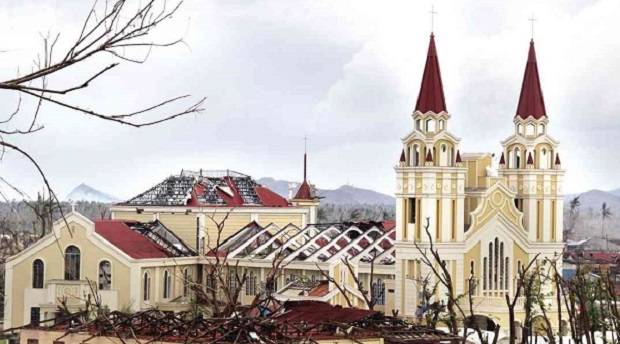 DAMAGED HOUSE OF GOD Supertyphoon “Yolanda” stripped Palo Metropolitan Cathedral of its roof and dome. Adlai Noel O. Velasco
PALO, Leyte—It was not the typical homecoming that I usually looked forward to.
I was at the Inquirer news desk on the day that Supertyphoon “Yolanda” pummeled the Eastern Visayas, including my home province of Leyte.
After initial reports of the devastation started to come in, particularly the news that there were already about 20 fatalities in my hometown of Palo, I felt a strong compulsion to go home.
Most of the victims came from a coastal barangay. They drowned after storm surges reaching as high as 6 meters engulfed the village and washed away the houses.
Completely isolated
I knew there would be more fatalities. But I had no way of confirming this as I was no longer able to contact my younger brother, Reuel, and his family and other relatives, after the supertyphoon destroyed all power and communication lines and completely isolated the province from the rest of the country and the world.
It was only two days later that I was finally able to talk to my brother. “Our roof was destroyed but we’re OK here,” he told me in Visayan via satellite phone.
I was relieved of the anxiety of not knowing, only for it to be replaced by worry over the likely damage done to our house.
Unsafe to live in
I had to go there to see for myself. But when to do so was the question. Things were getting out of control in Tacloban City and the place was no longer safe to visit, let alone live in. Everyone was rushing to get out.
There was no available public transport from Tacloban to Palo. The only alternative was a six-hour walk.
So I waited for the situation to normalize a bit.
It was only after mobile phone connection was partially restored that I finally decided to go home to Palo. I bought various sizes of tarpaulin from Binondo to use as a temporary roofing material. I also brought two generator sets.
But transporting them home was a problem since the only available form of travel to Leyte was by land, but that posed its own problems, mainly of security.
I later learned that a group of friends was going to Leyte by land for a relief and feeding mission for typhoon survivors in Tacloban and Palo. Calling itself “Because We Can,” the group was composed of volunteers from the National Press Club of the Philippines (NPC), Tuesday Club, Samahang Kartonista ng Pilipinas, Saturday Forum at Annabel’s and CDO Foodsphere.
The two-vehicle convoy left Manila for Matnog, Sorsogon, at 11 p.m. on Nov. 22, loaded with relief goods and food, and arrived in Tacloban City at 3 a.m. of Nov. 24.
Like a nuclear bomb
In Tacloban en route to Palo, I ran into a neighbor who told me that his wife had died during the typhoon’s onslaught. I could not find the words to console him. I just looked at him as he walked away. I felt it was a portent of things to come.
Indeed it was. As of Nov. 26, the number of fatalities in Palo had reached 1,085 and 92 were still missing.
When I finally reached Palo last Sunday, the sight of what Yolanda had wrought simply overwhelmed me. It looked like a nuclear bomb had been dropped over my hometown. Almost all the houses suffered damage of one form or another. Fallen trees and electric posts were strewn all over. There was debris everywhere.
Hardly recognizable
Except for the Palo Metropolitan Cathedral and the municipal hall, I could hardly find a structure that was recognizable.
The sheer force of the typhoon, which packed winds of more than 300 kilometer per hour, the world’s strongest typhoon on record, had altered the landscape and transformed Palo into a vast wasteland.
Stripped of their lush foliage and vegetation, the town’s surrounding hills and mountains became mere patches of brown. The big cross at the top of Guinhangdan Hill overlooking the town, ordinarily obscured by trees, was now completely visible.
Residents of Palo have been used to typhoons since Leyte is located in what climate experts call the “Typhoon Belt.” But for the past several years, the town has been largely spared from the more destructive weather disturbances, which seemed to have moved upwards to the Bicol and Quezon regions and downwards to Northern Mindanao.
But on Nov. 8, a date which will forever be etched in my memory, Palo was again on the direct path of a deadly typhoon. This time, it returned with a vengeance.
Unfamiliar terrain
I usually go home to Palo at least once a year, particularly for the town fiesta on Aug. 6. The last time I was there was on May 28 to attend my mother’s death anniversary. I therefore knew the place like the back of my hand. But this time, I found myself in unfamiliar terrain. I became lost in my own hometown.
When I finally regained my bearings, I noticed that the Palo Public Library on the ground floor of the old Pedrosa house had been severely damaged.
As a kid, I used to go to this library to borrow books.
Facing the library was the cathedral where I was baptized and where I heard Mass whenever I was in Palo. The entire cathedral roof had been blown away and its dome had collapsed.
While still in Manila, I had watched a TV footage of the cathedral’s roof being blown away. The sight was really depressing, particularly for the members of my family.
In 2009, our family which had been designated the main sponsor of the town fiesta that year, donated P2 million to the Archdiocese of Palo to jumpstart the fund-raising drive for the renovation of the cathedral. Construction began a year later and was finally finished in 2012.
But what took two years to renovate was destroyed in just three hours by Yolanda.
Fr. Bernie Pantin, the town’s parish priest, is appealing to donors for help in the cathedral’s reconstruction.
Despite the destruction, the diocese on Wednesday, held the closing ceremonies of its diamond jubilee celebrations amid heavy rain.
Depressing sight
Near the church was the damaged Palo campus of the University of the Philippines which used to be the Palo Puericulture Center, the town’s health clinic where I was born.
At the end of our street is the Palo Central School, where I finished my elementary education. Its roof had been blown away. Only its walls remain standing. For me this was a really depressing sight. I have fond memories of this school which I represented in several interschool quiz contests.
When I finally saw our house, I was relieved to see it had not been totaled, nor was it as badly damaged as I had feared. The roof of the second floor with its two bedrooms was ripped off by the howling winds but the roof over the sala, dining room and kitchen remained largely intact.
I felt we were still lucky after I saw that the collapsed houses of our neighbors and friends.
My niece, Carrie, showed a video she took as Yolanda pummeled the town. One could hear the ear-piercing sound of the winds which she described as similar to a jet engine preparing to take off. Outside the house, there was zero visibility. Everything appeared white. As the rains and winds battered the roof, I could hear my nephew, Jericho, praying the rosary, his voice growing louder and louder as the typhoon got stronger. They all huddled in the small corridor leading to the sala which was surrounded by solid cement walls and a narra door.
On the night before Yolanda’s onslaught, I had called up my younger brother to warn him to prepare for the world’s strongest typhoon which was coming their way and to stay in a safe place indoors.
But he sort of shrugged off my warning, saying the moon was bright and it was not even raining.
The next day, I called him up again but he could no longer be contacted.
Complete desolation
Surveying the coastal barangays of our town, all I could see was complete desolation. Most of the fatalities came from the barangays of Baras, Candahug, Cogon, San Joaquin and Salvacion. Entire clans were wiped out by the storm surge. Joel Agner, the newly elected barangay captain of Cogon, and six family members were killed.
More than two weeks after the killer typhoon, the stench of rotting corpses still lingers, a sign that there are still bodies that have to be recovered.
For residents of Palo, their horrifying ordeal was just another test of their endurance and resilience. They vowed to rise again from the catastrophe.
The messages on streamers hanging on the fence of the cathedral say it all: “Tindog, Paloanon!” (Rise up, Paloanons), “Bungto nga gintikangan, ayaw naton bayaan!” (Don’t foresake the town of your birth), “Ibalik naton an Palo! (Let’s rebuild Palo), “Palon-on ka, may mahihimo ka pa!” (You are a native of Palo, you can do something), “Lugar ng nag madulom, aton palamragon!” (Let’s brighten up our darkened place).
But out of despair and desolation came signs of hope and rebirth. Throughout my almost weeklong visit, I could hear the nonstop pounding of thousands of hammers driving into nails throughout the day and night. Palo (Visayan for wooden hammer) was rising from the rubble.
Read more: http://newsinfo.inquirer.net/537983/roofless-in-palo-lost-in-my-hometown#ixzz2mOVd6IH7
Name-shame tax drive targets rich
 MANILA, Philippines—The taxman has long struggled to compel the local elite to pay their fair share, but a name-and-shame campaign targeting one of history’s greatest boxers and the “sexiest woman alive” is aiming to change that.
A crusade against wealthy Filipinos is part of President Aquino’s high-profile effort to curb tax evasion throughout all sectors of society, a central plank of his quest to fight widespread corruption.
Boxing hero Manny Pacquiao became the latest to be caught in the cross-hairs when the Bureau of Internal Revenue (BIR) froze his bank accounts last week for his refusal to pay a P2.2-billion ($50-million) tax bill related to his earnings in the ring in 2008 and 2009.
The boxer says he has already paid the required taxes in the United States and paying in the Philippines would equate to double taxation.
While the champion appeared stunned and claimed he was being harassed, it was in fact just the latest strike by the BIR since Mr. Aquino came to power in 2010 that has targeted hundreds of rich or famous Filipinos.
“When ordinary people see that we are going after popular and well-known figures … it drives home the point that paying taxes is a civic duty,” Claro Ortiz, who runs the bureau’s Run After Tax Evaders (RATE) campaign, told Agence France-Presse.
The BIR has so far filed criminal complaints or charges against 200 wealthy Filipinos it accuses of avoiding a combined P44.45 billion in taxes.
Pacquiao, who is also a second-term congressman with ambitions of eventually becoming president, has not been charged. His case is currently a civil matter, with the BIR so far just demanding the money it says it is owed.
Solenn Heussaff charged
Among those facing criminal prosecution are actor-model celebrities, including Solenn Heussaff, named by the Philippine edition of Esquire magazine this year as “the sexiest woman alive.”
Heussaff disputes the charges that she owes P3.6 million in back taxes and has filed a legal challenge, although she also blames her accountant for any potential discrepancy.
National basketball team member Jim Alapag was one of several well-known athletes charged, for allegedly underdeclaring his income.

HEUSSAFF
Wealthy individuals who are away from the limelight are also being pursued, including a precious metals trader who allegedly failed to disclose more than a billion pesos’ worth of refined gold and silver sales to the central bank.
A man who raised suspicion because of a low salary and a Lamborghini sports car was another to be charged.
10 years in jail
Tax evasion is punishable by up to 10 years in jail.
However, those facing prosecution can have charges or criminal complaints dropped by cutting a deal with the BIR, or hope to have their case lost in the quicksand of the justice system.
Criminal cases in the country’s overwhelmed courts take an average of six years to complete, according to government data in 2010.
The Philippines is also infamous for a “culture of impunity” in which the wealthy or powerful are able to bribe, intimidate or otherwise use their influence so that they are rarely held accountable for crimes.
Just one person has been put behind bars for tax evasion since Aquino came to power in 2010, and her four-year prison term meted out last year stemmed from charges filed in 2005, according to the BIR.
Name and shame
But the government is banking on a wide range of name-and-shame techniques to fight tax evasion.
It regularly publishes in newspapers lists of top tax-paying companies in various industries—such as dining, hairdressing or accounting—and asks readers whether successful businesses they know of should be there.

ALAPAG
It also releases an annual list of the country’s wealthiest individuals and companies, highlighting the huge difference between their riches and taxes paid.
Occasionally there is also some direct presidential intervention.
In March, Mr. Aquino warned the Chinese-Filipino community to start paying taxes or face prosecution.
In an address to an annual meeting of the Federation of Filipino-Chinese Chambers of Commerce and Industry, the President said just 8 percent of its companies paid taxes.
Sixty percent of the chamber’s individual members paid no taxes at all, the President said in the speech that made national headlines.
P430B lost to evasion
The stakes are so high in the Philippines because tax evasion costs about P430 billion ($10 billion) each year, equivalent to 4 percent of the country’s gross domestic product, according to government estimates.
 Mr. Aquino says the unpaid taxes deprive the government of money to fight widespread poverty—about one quarter of the country’s 100 million people live on a dollar a day or less.
The government is claiming limited success in its campaign, citing tax collections having risen by 14 percent last year.
“There is an increase in tax compliance. We would like to think that the program played a role in that in terms of the fear factor,” said RATE leader Ortiz.
However, the government has also acknowledged there is a long way to go before tax evasion is tamed, and that the onus rests on whoever takes over from Mr. Aquino in 2016 to continue long-term anticorruption reforms.
Read more: http://newsinfo.inquirer.net/538255/embattled-bir-takes-aim-at-the-famous#ixzz2mOTaGxzQ
Subscribe to:
Comments (Atom)